
Why design-led brands should be using AI for Innovation and Product Development

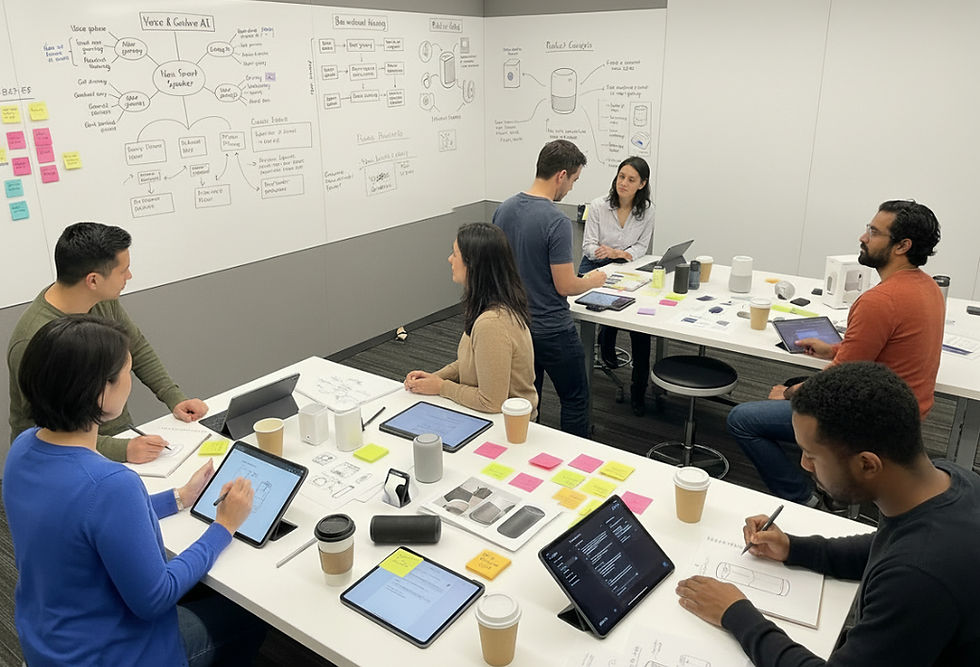
If you want to design and develop products that genuinely stand out (and don’t collapse under cost, delays, or poor validation), and to compete in a world where speed to market is key, you need a faster way to learn what works before you’ve spent months on the wrong project.
That’s where AI comes in...
...Not as a magic wand, and not as a replacement for your designers, engineers, or product leads. Used properly, Artificial Intelligence helps you accelerate the messy areas of innovation: research, synthesis, concept exploration, early prototyping, and decision-making. It gives you more opportunity to explore ideas, earlier idea validation, and fewer expensive mistakes, while you keep real designers in charge of taste, judgement, and compromises.
A simple definition:
AI in product development is the use of machine learning and generative tools to speed up how you discover insights, generate ideas, test assumptions, and evaluate decisions without skipping validation, engineering judgement, and design intent. The goal isn’t “more ideas”. The goal is better decisions, made earlier and faster.
Why this matters more for design-led brands
Design-led brands win when they do three things consistently:
They spot unmet needs, insights and opportunities before competitors do.
They translate those needs into a coherent product pipelines.
They launch products that are useful, usable, and commercially viable at scale.
The problem is that each of these steps is slow if you rely purely on manual effort. AI doesn’t remove uncertainty entirely but it does reduce the cost of research and development and decision making.
It can help you:
Investigate and summarise large volumes of fragmented consumer, competitor, and category information.
Generate multiple concept directions quickly (so you’re not married to the first idea).
Create early prototypes or “looks-like” visuals to test consumer likelihood to buy.
Produce clearer documentation so decisions don’t get lost.
AI is shifting from “using for efficiency” into a capability that changes how organisations approach innovation, especially around faster insights, faster iterations, and better decisions.
The Opportunity: Reducing time-to-learning
Most teams talk about speed as “time to launch”. But speed that matters is time to learning:
How quickly can you find out if a problem is worth it?
How quickly can you find out if consumers will buy your idea?
How quickly can you find out if your solution is scalable at the target cost?
How quickly can you decide on what you’re not doing (as a team)?
AI helps because it’s great at research, pattern-finding, synthesising, and prototype creation - the parts of innovation that usually slow down the pipeline or project.
"When you combine that with design (human-centred, iterative, evidence-led), you get the best of both worlds: Machine acceleration plus human judgement."
What most UK SMEs get wrong with AI (so you can avoid it)
Two mistakes show up a lot:
AI is viewed as a playful toy - Some team members experiment, outputs initially look impressive, but nothing connects to a real project or KPI. This turns into AI chaos: lots of random activity but with no transformation.
AI is viewed as a shortcut - Teams try to use AI to quickly skip key steps like discovery and validation. That usually means you generate surface-level ideas built on unproven assumptions and you still pay the price later on at launch, leading to potential pivots or lots of tech-debt.
Conclusion
If you’re looking to improve your innovation efforts with AI, you don’t need more noise, you need a practical way to decide:
Where AI actually fits in your research, design, and development workflow
What you should NOT automate
And how to maintain quality, IP, and accountability intact whilst moving faster.

Comments